Maintaining proper humidity is crucial for successful indoor grows. The right dehumidifier helps protect plants from mold, improves air quality, and reduces humidity-related issues in grow tents and rooms. This guide highlights five high-efficiency dehumidifiers suitable for grow environments, balancing performance, energy efficiency, and ease of use. Each pick supports either external ducting or convenient drainage, helps manage humidity precisely, and accommodates spaces from compact tents to larger grow rooms. The quick-reference summary below shows key specs to compare at a glance.
| Product | Brand | Max Pints/Day | Best For | Drainage |
|---|---|---|---|---|
| Spider Farmer Upgraded Dehumidifier | Spider Farmer | 32 | Grow tents up to 2000 sq ft | Drain hose included |
| Moiswell 190 Pints Commercial Dehumidifier | Moiswell | 190 | Large spaces and grow rooms | Built-in pump drainage |
| Dreo 110-Pint Smart Dehumidifier | Dreo | 110 | Spaces up to 4500 sq ft | Drain hose included |
| KNKA 2500 Sq. Ft Dehumidifier | KNKA | 34 | Basements and large rooms | Manual or hose drainage |
| Waykar 80 Pints Energy Star Dehumidifier | Waykar | 80 | Large spaces up to 5000 sq ft | Drain hose included |
Choosing the right unit involves balancing space size, humidity targets, and drainage preferences. The products below are selected for grow environments, offering strong dehumidification, energy efficiency, and practical placement options. Review each section to find how a model aligns with tent setups, basements, and larger grow rooms alike.
Spider Farmer Grow Tent Dehumidifier

This Spider Farmer model is designed with a grow tent workflow in mind. A dedicated air duct lets the unit run outside the tent, avoiding extra heat inside the growing space that could stress crops. It can remove up to 32 pints of moisture per day under typical hot, humid conditions, and is rated for tents up to 2000 square feet in coverage, making it suitable for 3×3, 2×4, and 4×4 tent configurations. The unit includes a 24-hour timer to cut energy use, three selectable modes, and an automatic defrost function to operate reliably in cooler environments. Humidity can be set from 30% to 80%, and a sensor probe provides real-time readings on the screen, so growers can monitor conditions at a glance. It automatically stops when the target humidity is reached, helping maintain a stable, mold-free environment in the grow area.
Moiswell 190 Pints Commercial Dehumidifier

The Moiswell unit is built for aggressive moisture control in large grow rooms, warehouses, or particularly damp basements. It delivers up to 190 pints per day, with AHAM-rated performance around 90 pints daily, making it well-suited for expansive spaces. A high airflow output of 265 CFM speeds up drying, helping protect structural wood, equipment, and crops from excessive humidity. The device includes a built-in pump for drain-out vertical distances up to about 16.4 feet, enabling hands-free drainage in spaces without convenient floor drainage. Its rugged design and automatic defrost help maintain continuous operation in challenging environments, making it a strong option for commercial-scale grow setups that demand consistent humidity control.
Dreo 110-Pint Smart Dehumidifier

The Dreo 110-Pint Smart Dehumidifier provides robust moisture removal for large spaces, with performance up to 110 pints per day and coverage suitable for areas up to about 4500 square feet. Energy efficiency is a key feature, delivering up to 4.0 pints per kilowatt-hour, which helps reduce operating costs over time. It offers three customizable modes—Comfort, Auto, and Continuous—for flexible humidity control, and a built-in precision humidity sensor automatically adjusts fan speed to maintain the selected target with a tolerance around 5%. The unit ships with a drain hose for continuous drainage, minimizing manual tank emptying during lengthy grow cycles. A clean control panel and visible humidity readout support precise management of moisture in the grow space.
KNKA 2500 Sq. Ft Dehumidifier

KNKA’s 2500 sq ft dehumidifier targets mid-to-large spaces with a balanced feature set. It removes up to 34 pints per day under 95°F and 90% RH, making it suitable for basements, large rooms, and adjacent grow areas. The unit offers three smart modes—DEHU, DRY, and CONT—so you can automatically regulate humidity, accelerate clothing drying, or run continuously in very damp zones. There are two drainage options: manual tank drain or continuous drainage via the included hose, which is convenient for spaces with adequate drainage. A 3-liter tank shuts off automatically when full, and the intelligent humidity control helps prevent over-dehumidification while preserving crop-friendly conditions.
Waykar 80 Pints Energy Star Dehumidifier
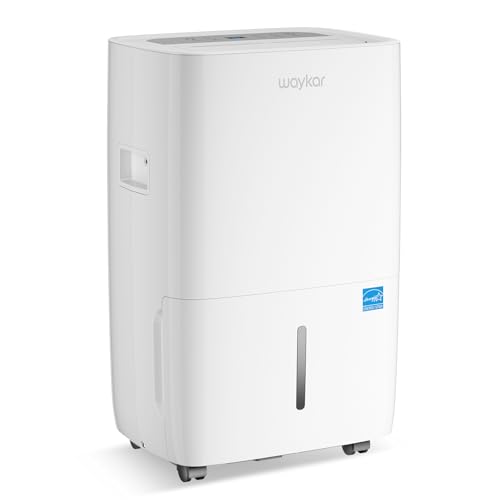
Waykar’s 80-pint unit is designed for larger spaces up to 5000 square feet, making it a strong choice for sizable grow rooms or finished basements. It carries Energy Star certification, which translates into greater efficiency and lower operating costs. The unit delivers up to 80 pints per day and includes a drain hose for continuous drainage, reducing the need to empty a tank during long cultivation cycles. It supports an adjustable humidity range from 30% to 80% and features a broad fan-angle of 30°–90° to optimize air distribution across damp corners, closets, or workspaces. A quiet operation profile and simple controls help maintain a stable grow environment with minimal intervention.
Buying Guide
Key considerations help determine the best dehumidifier for a grow room or tent. Start with space size and target humidity, then match capacity in pints per day to avoid under- or over-drying. For tents, units that support ducting or external placement minimize heat in the growing space and protect plant health. Drainage options matter: a built-in pump or long drainage hose reduces manual maintenance during long cycles, while manual tank drains are simpler but require attention. Energy efficiency matters for ongoing operation—Energy Star models typically offer lower running costs over time. Noise levels can influence placement, especially in bedrooms or shared spaces. Smart features such as humidity sensors, automatic shutoff, and auto modes help maintain precise conditions without constant monitoring. Maintenance needs, such as filter cleaning and defrost cycles, affect reliability and longevity in humid grow environments. Compare performance metrics like maximum pints per day, coverage area, and the ability to maintain stable humidity across a range of temperatures to choose the best fit. For grow tents, consider whether the unit can operate effectively when mounted outside the tent with ducting, or whether a compact, inside-tent model better suits the space constraints. Evaluate overall system goals: rapid humidity reduction for flower cycles, continuous control for vegetative growth, or a balance of both with flexible modes.
In sum, the optimal dehumidifier for a grow room combines sufficient dehumidification capacity with flexible drainage, energy efficiency, and quiet operation. Larger spaces benefit from higher pints-per-day ratings and external drainage options, while smaller tents require ducting-enabled units and precise humidity control. When selecting, align the model’s strengths with your grow setup’s layout, climate, and plant species to achieve consistent, healthy yields.